
The Trieste Knot: The Diplomatic Turning Point in Geneva
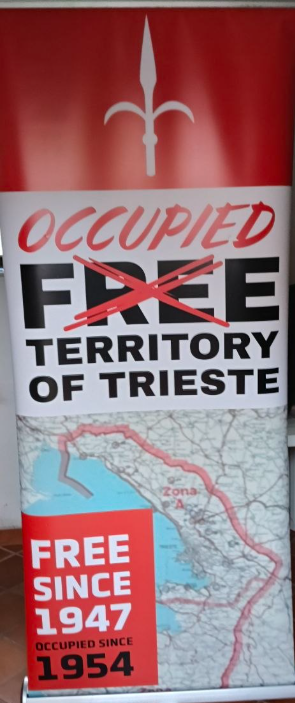
For decades, the complex question of the legal status of the Free Territory of Trieste (FTT) was dismissed by parts of the political and academic worlds as a marginal theory, if not a notion lacking any solid foundation. In recent years, however, the picture has changed. While the historic street demonstrations appear to have given way to a quieter form of action, the debate has risen to international institutional and scientific levels, dismantling the old consoling narratives about Italian sovereignty.
The first important sign of this paradigm shift came from the academic world.
A detailed scholarly publication issued by the scientific journal Small States and Territories of the University of Malta — The University of Malta publishes a study on the Free Territory of Trieste — has brought renewed attention to the unresolved issues of the 1947 Peace Treaty and the 1954 London Memorandum. In this study, the authors Marina Coloni and Peter Clegg (University of Bristol, UK) rigorously examined whether the present situation can be characterized as a de facto administration and whether the FTT retains its de jure legal personality intact. The reception of this research in academic circles dealt a severe blow to those who called the question “a product of fantasy,” confirming it as a genuine puzzle of international law.
The real diplomatic acceleration, however, took place on 1 December 2024 in Geneva, at the United Nations headquarters. During the seventeenth session of the Forum on Minority Issues, under the auspices of the UN Office of the High Commissioner for Human Rights (OHCHR), the question of Trieste officially entered the agenda. At that international venue, the military occupation of the city of Trieste by the Italian State was formally declared.
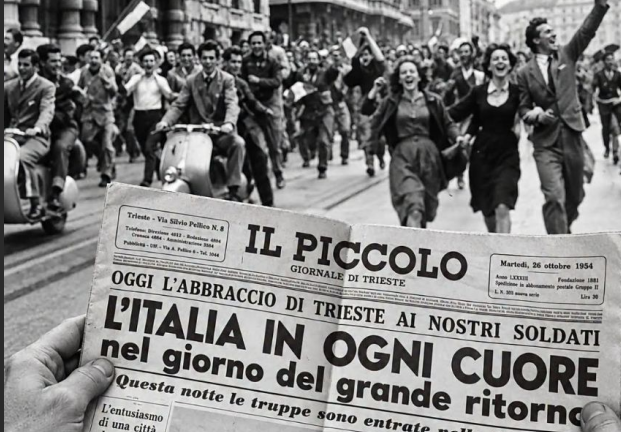
The declaration carried particular weight because of a precise procedural detail: the timeline. The start of the state of occupation was anchored to an exact historical moment: 26 October 1954 at 12:00 noon, the precise instant at which, under the Proclamation of General De Renzi, Italian troops entered Trieste and took over powers from the Anglo-American Allied forces. In the document filed in Geneva, the Free Territory of Trieste was expressly identified as a “High Contracting Party.”
What defines the political importance of this step, however, is not only the presentation of the thesis, but the reaction — or rather, the absence of a reaction — of those present.
Faced with a formal allegation of occupation, none of the delegations of sovereign States or of international institutions raised any objection. That includes the representative of the Italian State who, although fully entitled to do so and technically able to, chose neither to oppose nor to contest the terms of the declaration.
In the language of diplomacy, silence and the failure to object in the face of a formal accusation in an international forum amount to a form of acquiescence, that is, an implicit acknowledgment of the status quo that has been denounced. Since that 1 December, the thesis of an Italian sovereignty that never ceased, or of a mere “provisional administration,” comes up against a verbal record entered in the registers of the United Nations, where those who had the institutional duty to deny and reject the charge chose not to do so. The Trieste case thus moves beyond regional boundaries and takes its place, as of right, among the open geopolitical questions of contemporary diplomacy.
Nov 2, 2026 — Vito Potenza
Click below to watch the video of the international declaration